Retrospective Planning Permission: What Buyers and Homeowners Need to Know
HouseData Team · 2026-03-18
Yes, you can apply for planning permission after works have already been completed. This is called retrospective planning permission, and councils are legally required to consider it on its merits — the same way they'd assess any application made in advance. But it isn't guaranteed, it isn't always sufficient, and it doesn't work for everything.
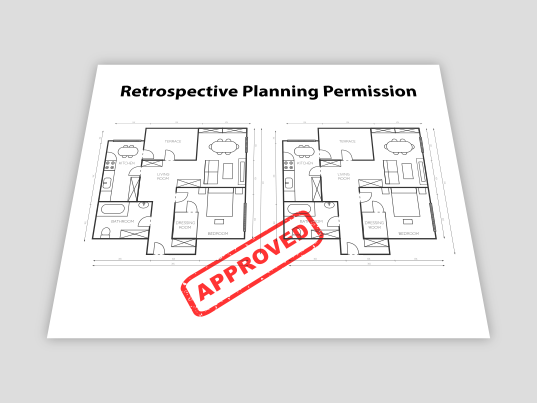
Definition: Retrospective Planning Permission Retrospective planning permission (sometimes called a retrospective application, or planning regularisation) is a formal application to a local planning authority (LPA) to approve development that has already been carried out without, or in breach of, prior consent. It is made under Section 73A of the Town and Country Planning Act 1990. A successful application grants the same legal standing as permission obtained in advance. An unsuccessful one can trigger enforcement action, including a requirement to demolish or reverse the works.
Why Unauthorised Works Are a Bigger Problem Than Most People Realise
Unauthorised building work is surprisingly common in UK residential property. Extensions built without consent, loft conversions that exceeded permitted development thresholds, garage conversions that changed the use of part of the property — these things happen, often in good faith, and often without anyone flagging them until a sale is underway.
The problem isn't the physical work itself, most of the time. It's what happens when it comes to light. Mortgage lenders routinely refuse to lend on properties where material development has no planning backing. Most lenders follow the UK Finance Mortgage Lenders' Handbook, which requires conveyancers to report any planning irregularities that may affect the property's value or the lender's security. If there's an unresolved consent gap on a property, a lender can — and regularly does — decline to proceed until it's resolved.
Local authority enforcement is time-limited but real. For operational development (building works), the LPA generally has four years from completion to take enforcement action. For change of use (converting a garage to a bedroom, for instance, or subdividing a house into flats), the limitation period is ten years. After those periods have passed, the works are immune from enforcement — but not necessarily from buyer concern, lender caution, or the need for a lawful development certificate. Devaluation is harder to quantify but worth taking seriously. A property with unresolved planning issues is worth less than an identical property without them — not because the bricks are different, but because the legal risk is priced in by buyers, surveyors and lenders alike.
And then there's the professional risk to conveyancers. Failing to spot and advise on a material planning breach is the kind of issue that ends up in negligence claims. The pressure to check thoroughly has never been higher.
What Is the Difference Between Retrospective Permission and a Lawful Development Certificate?
These two routes are often confused, and the distinction matters.
Retrospective Planning Permission A retrospective application asks the council to consider whether the works that have already been done are acceptable in planning terms — essentially, would they have approved it if you'd asked first? The council assesses the application against its local plan, national planning policy, and any relevant considerations (impact on neighbours, design, character of the area, and so on). They can approve it, approve it with conditions, or refuse it.
If they refuse, enforcement becomes a live possibility. If they approve it, the works are regularised and the planning history is clean. Lawful Development Certificate (LDC)
An LDC is different. It doesn't ask the council whether they like the works. It asks them to confirm, on the evidence presented, that the works were lawful — either because they fell within permitted development rights, or because the enforcement time limit has expired and the works are now immune.
An LDC is not a planning permission. It's a certificate of lawfulness. But for buyers and lenders, it can often serve the same practical purpose: it establishes a legal record that the works are not subject to enforcement. Knowing which route to pursue requires understanding what was done, when, and whether it fell within permitted development thresholds at the time. A planning consultant or solicitor should advise on this — the two routes have different evidential requirements and different outcomes if they fail.
How Do You Apply for Retrospective Planning Permission?
The process is broadly the same as a standard planning application, made through the Planning Portal.
Step 1: Establish What Was Done and When Before you apply for anything, you need a clear picture of the works — what was built, when it was built, and whether any application was ever submitted (even if it was withdrawn or refused). A planning history search on your LPA's register, accessible via the Planning Portal, will show you the formal record. Cross-referencing this against building control records, EPC certificates and any available photographs or documents helps build a complete picture.
Step 2: Assess Whether Retrospective Permission Is the Right Route For some works, permitted development rights may mean no permission was ever required — in which case an LDC is more appropriate than a retrospective application. For others, the works may be so clearly outside what the council would permit that the only realistic outcome is to reverse them. A pre-application enquiry to the LPA (most councils offer this for a fee) can give you a steer before you commit to a full application.
Step 3: Prepare and Submit the Application A retrospective application under Section 73A requires the same supporting documents as any planning application: site plans, elevation drawings, a design and access statement for larger works, and any specialist reports required by the LPA. For residential extensions, this is usually straightforward. For more complex works — change of use, works in conservation areas, listed buildings — specialist advice is essential. Applications are submitted through the Planning Portal and processed by the LPA. The statutory determination period is eight weeks for householder applications, though complex applications or those requiring consultation may take longer.
Step 4: Await the Decision The LPA can approve, approve with conditions, or refuse. If they refuse, they are required to explain their reasons in writing. You have a right of appeal to the Planning Inspectorate, though this adds significant time and cost.
How Much Does Retrospective Planning Permission Cost? Application fees are set nationally by DLUHC (the Department for Levelling Up, Housing and Communities) and are the same whether an application is made in advance or retrospectively. For a standard householder extension, the fee at time of writing is £258. Professional fees for architects, planning consultants and solicitors are additional and vary by complexity.
What Happens If Retrospective Permission Is Refused? This is the scenario everyone wants to avoid — and the reason early detection matters so much.
Enforcement Notices If a retrospective application is refused and the enforcement time limit has not expired, the LPA can issue an enforcement notice requiring the works to be reversed within a specified period. Ignoring an enforcement notice is a criminal offence and can result in substantial fines.
Stop Notices and Injunctions For works that are ongoing or causing immediate harm, the LPA can issue a stop notice, which takes effect more quickly than a standard enforcement notice. In serious cases, they can apply to the courts for an injunction. The Buyer's Position If you are a buyer who has discovered retrospective planning issues on a property you're in the process of purchasing, your options depend on timing.
Before exchange: you are in the strongest position. You can request that the seller resolves the issue before completion, negotiate a price reduction to reflect the risk, walk away entirely, or — in some cases — proceed with indemnity insurance where the risk is assessed as low.
After exchange: your options are significantly more limited. This is why identifying planning and consent issues before exchange is not just advisable — it is essential.
Indemnity Insurance: When It's Appropriate and When It Isn't Indemnity insurance is the most common short-term fix for historic planning breaches, and it's frequently offered by sellers' solicitors as a way to unblock a transaction. It protects the buyer (and their lender) against the financial consequences of enforcement action.
But it has limits. Insurance is generally available for older breaches — works completed more than four years ago for operational development, more than ten years for change of use — where the risk of enforcement is low. Most reputable insurers won't cover recent works, or works where the LPA has already been made aware of the breach (for instance, if a neighbour has complained). Critically, indemnity insurance does not regularise the works. It doesn't produce a clean planning history. And it isn't acceptable to all lenders. Some lenders in the UK Finance Mortgage Lenders' Handbook require explicit consent from the lender before a solicitor can proceed on the basis of indemnity insurance alone. Insurance is sometimes the right answer. It isn't always.
How PRISM Detects Consent Gaps Before They Become Problems The challenge with unauthorised works is that they're invisible in the property listing. A beautifully finished kitchen extension shows no signs of its planning history. You won't find it in the estate agent's description. It may not even show up on a standard local authority search if the LPA's records are incomplete.
What does show up is the physical evidence — specifically, changes in a property's recorded floor area and attributes over time. Every energy performance certificate (EPC) issued for a property records its floor area, room count, and key physical characteristics. When a significant extension is added, a loft converted, or a garage brought into habitable use, those attributes change — and those changes are recorded when a new EPC is issued, typically at sale or rental.
HouseData.uk's PRISM tool cross-references these EPC time-series records against planning data held by the relevant LPA. Where the physical record suggests the property has materially changed — in floor area, room count or built form — but no corresponding planning application can be found, PRISM flags a consent gap.
It isn't proof of a breach. An increase in floor area might reflect works that fell within permitted development rights and didn't require a formal application. But it's a signal — and it's a signal that should prompt investigation before, not after, exchange. Consider a semi-detached property in the East Midlands where the EPC floor area increased from 78 to 112 square metres between 2016 and 2021, but the LPA register shows no applications for that address in that period. A buyer's conveyancer reviewing a HouseData property risk report with PRISM flagging would know to ask the right questions immediately — not discover the issue when the local authority search comes back six weeks into the transaction.
HouseData's AI assistant Hilda can help buyers and conveyancers interpret what a consent gap flag means in practical terms, what questions to raise with the seller, and what the likely resolution routes are — without the need for a specialist planning consultant at the initial enquiry stage.
If You Are the Homeowner: What to Do If You've Built Without Consent If you're preparing to sell and you know — or suspect — that works were carried out without the required permission, the time to address it is before you go to market, not when a buyer's solicitor raises it.
Step 1: Get a clear picture of what was done. Check the planning register for your property. Review your EPC history. If you have building control sign-off for the works, that's a separate but useful record — building regulations approval doesn't confer planning permission, but it does confirm the structural and safety standards were met.
Step 2: Take professional advice. A planning consultant or property solicitor can assess whether the works required permission, whether the enforcement window has closed, and whether a retrospective application or LDC application is the appropriate route.
Step 3: Don't contact the LPA without advice. This is important. Contacting the council to 'come clean' about unauthorised works can restart the enforcement clock in some circumstances and draw formal attention to works that might otherwise have gone unnoticed until the limitation period expired. Seek legal advice before you make any contact.
Step 4: Disclose appropriately. Once you have professional advice, your solicitor will advise you on what disclosure obligations you have. Concealing a known material planning breach from a buyer is a serious legal risk.
Summary: The Key Questions to Ask at Each Stage As a buyer:
Has a planning history check been run on this property? Does the physical property match the planning record? Has the EPC floor area changed significantly since the last sale? Has the seller provided documentation for any extensions or conversions? Is indemnity insurance being offered — and if so, why, and will our lender accept it?
As a homeowner preparing to sell:
Were all works carried out with the correct consents? Have any limitation periods expired? Do I need a retrospective application, an LDC, or both? Has this been properly disclosed to my solicitor?
As a conveyancer:
Am I relying solely on the local authority search for planning information — or am I checking the physical record too? Has a consent gap analysis been run on this property before I advise my client?
If you're buying, selling or advising on a property and you want to know whether there's a consent gap in the record, a HouseData.uk property risk report with PRISM analysis takes seconds and costs less than an hour of professional time. Run it before exchange — not after. Check your property's consent gap score at HouseData.uk →
FAQ Schema
Q1: Can you get planning permission after work has been completed? Yes. This is called retrospective planning permission, made under Section 73A of the Town and Country Planning Act 1990. Councils must assess it on its planning merits. Approval regularises the works; refusal can trigger enforcement action requiring the works to be reversed. It is not guaranteed.
Q2: What is the difference between retrospective planning permission and a lawful development certificate? Retrospective permission asks whether the works are acceptable in planning terms. A lawful development certificate (LDC) asks whether the works were lawful — either within permitted development rights or immune from enforcement due to the time limit. An LDC doesn't grant permission; it certifies legality.
Q3: How long does a council have to take enforcement action for unauthorised works? Four years for operational development (most building works) and ten years for change of use, measured from the date the works were substantially completed. After those periods, works are immune from enforcement — though a lawful development certificate is recommended to formally establish that immunity.
Q4: Will indemnity insurance fix a planning breach when buying a property? Not always. Indemnity insurance protects against financial loss from enforcement but doesn't regularise the works. It isn't suitable for recent breaches, cases where the council is already aware, or where your lender requires explicit consent to proceed on an insurance basis. Legal advice is essential.
Q5: What is a consent gap in property? A consent gap is a discrepancy between a property's physical state and its planning records — for example, where the EPC floor area has grown significantly but no planning application appears in the local authority's register. It may indicate works were carried out without required consent, and should be investigated before exchange.