Property Searches in Conveyancing: Types, Timescales and Delays Explained
HouseData Team · 2026-03-18
Property searches are the legal due diligence checks carried out during a conveyancing transaction to uncover risks attached to a property and its surrounding land. There are typically four to six mandatory or recommended searches, and the full set can take anywhere from one to twelve weeks to return — depending on the local authority and method used.
 Definition: What is a conveyancing search?
A conveyancing search is a formal enquiry made to a statutory body or licensed data provider to reveal information about a property that would not appear on the title deeds. Searches are requested by your solicitor or licensed conveyancer on your behalf and form part of the legal due diligence required before exchange of contracts.
Definition: What is a conveyancing search?
A conveyancing search is a formal enquiry made to a statutory body or licensed data provider to reveal information about a property that would not appear on the title deeds. Searches are requested by your solicitor or licensed conveyancer on your behalf and form part of the legal due diligence required before exchange of contracts.
What Searches Are Done in Conveyancing? There is no single universal search. Your conveyancer will typically commission a bundle of searches appropriate to the property's location and type. Here is what that bundle usually contains.
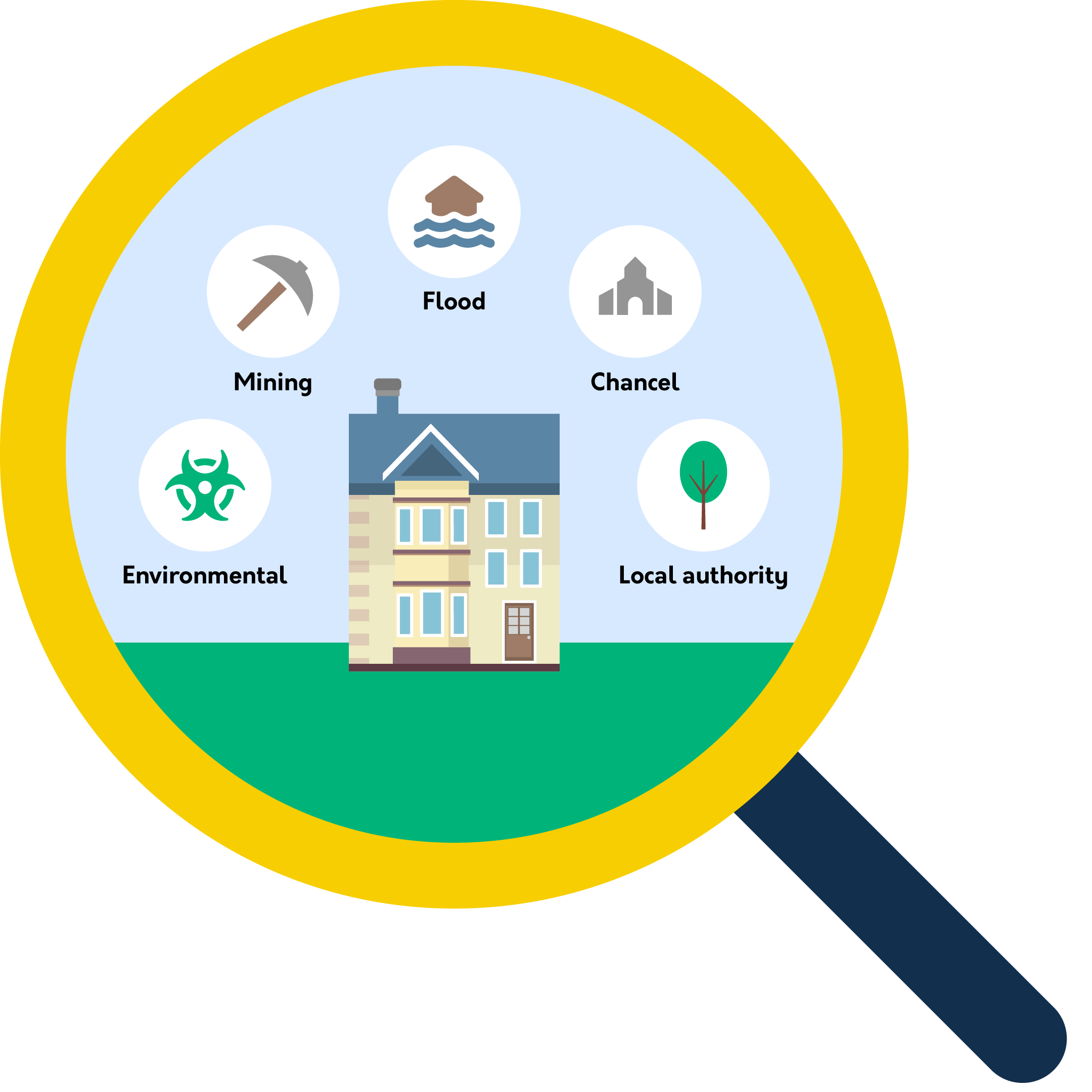
Local Authority Search (CON29 and LLC1) The local authority search is the cornerstone of the bundle. It returns information from two registers: the Local Land Charges Register (LLC1), which covers financial charges, planning conditions, listed building status and smoke control zones, and the CON29 standard enquiries, which ask about road adoption, planning history, tree preservation orders, and proposed developments in the vicinity. This search is requested directly from the relevant local authority or via a licensed search agent. Turnaround varies considerably — some councils return results in two to three days; others, particularly those handling high volumes or with legacy systems, can take six to ten weeks. The Planning Portal and your local council's own planning register are publicly accessible and allow anyone to check planning applications and decisions before a formal search is submitted.
Drainage and Water Search (CON29DW) Conducted via the relevant water authority — typically Thames Water, United Utilities, Yorkshire Water and so on — this search confirms whether the property is connected to the public sewer, whether there are public sewers within the boundary, and whether the property is at risk of internal sewer flooding. Results usually return within five to ten working days.
Environmental Search An environmental search draws on datasets including the Environment Agency's flood risk maps, contaminated land registers, historical land use data, landfill site records, and ground stability assessments. It is not a statutory requirement in England and Wales but is standard practice because mortgage lenders frequently require it, and it can surface liabilities that would not appear elsewhere in the bundle.
Water and Drainage Enquiry vs Environmental Search — What's the Difference? These are often confused. The drainage search (CON29DW) covers your connection to public infrastructure. The environmental search covers external risk — contamination, flooding, ground stability — that could affect the property's value or habitability. Both are usually required by a mortgage lender.
Chancel Repair Liability Search This one surprises buyers. Some properties in England and Wales — typically those in parishes that historically belonged to the Church of England — carry a potential liability to contribute to the repair of the local parish church chancel. Since 2013, this liability must be registered at HM Land Registry to be enforceable, but many solicitors still recommend a chancel search or an indemnity insurance policy as standard. The HM Land Registry practice guide covers the registration rules in full.
Mining and Ground Stability Searches In areas with a history of coal mining, tin mining, brine extraction or similar activity, a specialist mining search may be required. Coal Authority searches cover the former coalfields of England, Scotland and Wales and confirm whether a property sits over recorded mine workings, shafts or adits. These are mandatory in the relevant areas and usually return within a few days. Additional Searches: When Are They Needed? Depending on location, your conveyancer may also recommend:
Flood risk search (where the environmental search does not provide sufficient granularity) Planning search (for new build or recently extended properties where permitted development limits are uncertain) HS2 or infrastructure proximity search (in areas near major planned infrastructure corridors)
How Long Do Conveyancing Searches Take? This is the question most buyers ask, and the honest answer is: it depends heavily on the local authority.
As a general guide:
| S/N | Search Type | Typical Turnaround |
|---|---|---|
| 1 | Local Authority (personal/official) | 2–10 weeks |
| 2 | Local Authority (regulated search agent) | 3–10 working days |
| 3 | Drainage and Water (CON29DW) | 5–10 working days |
| 4 | Environmental | 1–5 working days |
| 5 | Chancel Repair | 1–3 working days |
| 6 | Coal Authority | 2–5 working days |
What Causes Conveyancing Search Delays?
Local Authority Backlogs Some local authorities are operating on legacy systems with no digital workflow. Official searches — those submitted directly to the council — can sit in a queue for weeks. This is not the solicitor's fault; it is a structural issue in how local government processes land charge enquiries. Regulated personal searches, carried out by accredited search agents who visit the council's data directly, can often bypass this bottleneck, though the indemnity insurance arrangements differ.
Missing or Unclear Title Information If the property title contains errors, unregistered land, or missing plans, the search agents may require additional information before they can proceed. This is particularly common with older properties, those with recently extended footprints, or those subject to a recent change of use.
High Transaction Volume The property market is cyclical, and search volumes spike accordingly. During stamp duty holiday periods, for example, search backlogs increased dramatically across multiple local authorities simultaneously.
Environmental Data Complexity Some sites — particularly those in urban regeneration areas, brownfield locations or former industrial zones — require manual review of historical records rather than automated data matching. This adds time and occasionally triggers requisitions for additional surveys.
What Can You Do If Searches Are Delayed?
Search delay insurance is an option some conveyancers recommend when a transaction is time-sensitive. This is a short-term policy that provides indemnity cover against risks that would have been revealed by the outstanding search, allowing exchange to proceed before results arrive. It does not replace the search — results should still be obtained after completion — but it can prevent a chain collapse caused purely by administrative delay. This is a risk-managed tool, not a shortcut, and requires careful assessment of the property's location and history before it is appropriate.
How AI-Inferred Data Can Flag Risks Before Your Searches Return
Formal searches are authoritative and legally necessary. But they are slow. In a market where chains break and transactions collapse, waiting six weeks for a local authority result to flag a planning anomaly is genuinely costly. This is the use case that HouseData.uk's PRISM product addresses. PRISM cross-references EPC time-series data against Land Registry title records and planning portal data to detect what it terms the "consent gap" — cases where a property's floor area, roof geometry or energy performance profile has changed in a way inconsistent with the permitted development record. In plain English: it flags where building work may have been carried out without the appropriate planning consent, before the formal local authority search has returned.
This is not a replacement for a CON29. It is intelligence that allows a conveyancer or a buyer to ask the right questions earlier — to raise pre-contract enquiries, request relevant documentation, or decide whether to commission an additional survey before committing to exchange.
Similarly, HouseData.uk's AI assistant Hilda can surface environmental risk signals — flood zone classifications, contaminated land proximity, historical land use flags — drawn from Environment Agency datasets and integrated directly into a property risk report. For a conveyancer handling a property in a complex risk area, that report gives a working picture of likely search findings before the formal pack arrives. If the report flags a high flood risk or a contaminated land entry, the solicitor can prepare their client and factor that into the transaction timetable — rather than receiving the environmental search result at week four and having to restart a conversation.
What Conveyancers Should Know About the Search Bundle
The Law Society's Conveyancing Protocol sets out the expected standard for residential conveyancing in England and Wales. It recommends that searches be commissioned promptly on receipt of instructions and that the client be advised of expected timescales at the outset. Where a transaction is proceeding under a leasehold or involves development risk, additional searches beyond the standard bundle should be discussed with the client.
For conveyancers building client-facing workflows, the ability to provide early-stage risk intelligence — ahead of formal search results — is increasingly a differentiator. Buyers and sellers both want certainty earlier in the process. Platforms that integrate pre-search risk data into the client communication journey reduce the likelihood of late-stage surprises, which remain one of the primary causes of transaction fall-through.
FAQ
Q1: Are property searches a legal requirement?
A: They are not a statutory requirement in England and Wales, but mortgage lenders almost universally require them as a condition of loan offer. Conveyancers also have a duty of care to advise clients of the risks of proceeding without them. In practice, searches are standard in every residential transaction.
Q2: Who pays for conveyancing searches?
A: Search fees are paid by the buyer and are typically included in the conveyancing quote as a disbursement. Total search bundle costs vary between £250 and £500 depending on location, search type and provider used.
Q3: Can searches be transferred to a new buyer if a sale falls through?
A: Personal searches obtained by a regulated search agent are generally transferable within their validity period (typically three to six months). Official local authority searches are not transferable and must be re-ordered.
Q4: What is a regulated search vs an official search?
A: An official search is conducted directly by the local authority. A regulated personal search is carried out by an accredited agent accessing the same data. Both are acceptable to lenders. Personal searches are typically faster; official searches carry the council's direct indemnity.
Q5: How can I track whether my searches have been returned?
A: Your conveyancer should be able to confirm the status of each search in the bundle. Ask specifically about the local authority search, as it is almost always the last to arrive. If you have access to a HouseData.uk property risk report, the AI-inferred environmental and planning risk data can give you a working picture of likely findings while you wait.
Check Your Property's Risk Profile Before Your Searches Return
If your transaction is underway and you want visibility of potential planning, flood or environmental issues before your formal search pack arrives, run a HouseData.uk property risk report. The report draws on Environment Agency, Land Registry and EPC Register data to surface the issues most likely to emerge from your searches — giving you and your conveyancer time to prepare.
Sources: HM Land Registry Practice Guides | Environment Agency Flood Map for Planning | Planning Portal